
· Nora Whitfield
Can you use a mason jar for a sourdough starter? Yes — done right
Search for a photo of a sourdough starter and odds are it is sitting in a mason jar. The pairing is so common it barely registers — and yet the question keeps being asked, because the jar was designed for canning, not for a culture that rises, breathes and eats every day. The short answer is yes, and this guide covers only the mason-jar specifics: which mouth, which size, and what to do about the lid. The material case — why glass at all — is made in full on why a glass jar is the right home for a starter, and the criteria that apply to any jar, mason or otherwise, live on what makes a good starter jar. Neither is repeated here.
Why the answer is yes
The case for the mason jar is short and solid. It is glass, and glass is inert: a starter is acidic, and acid in permanent contact with bare metal or scratched plastic is the one situation to avoid. It is clear, so the level and the bubble structure reach you through the wall. It comes in a size — the quart — that lands almost exactly where a home starter needs it. And there is probably one in your kitchen already, which means the distance between deciding to keep a starter and actually keeping one is zero.
It was still designed for a different job. A canning jar exists to be filled once, sealed hard, heated, and left alone on a shelf for a year. A starter jar is opened twice a day, scraped along its walls, read through its side, and must let gas out continuously. Those two jobs overlap on the glass and part company on everything that screws onto it.
So the yes comes with three decisions, and each has a clearly wrong option: the mouth, the size, and the lid.
Wide mouth or regular mouth: wide, and it is not close
Mason jars come with two openings, and for canning the choice is mostly about what fits through the neck. For a starter the choice decides how the jar behaves every single day.
A regular-mouth jar narrows above the body into a curved shoulder before it reaches the rim. That shoulder is the problem. Every feed, starter climbs the walls, and the ring of it that sits up under the curve is exactly where a spatula cannot follow. It dries there, feed after feed, into a crust you can see through the glass and cannot reach through the opening. Feeding is no better: flour tipped through a narrow neck dusts the rim and the threads instead of landing in the culture, and a hand does not fit inside at all.
A wide-mouth jar runs almost straight from base to rim. A hand and a spatula fit through together, one pass takes the whole wall down, and flour goes where you aimed it. The daily scrape that keeps a starter jar clean — the ten-second habit described in how to clean a starter jar — is only a ten-second habit when the geometry allows it. In a regular-mouth jar it becomes an excavation, and habits that become excavations get skipped.
If the only jar in the house is regular-mouth, it will still keep a starter alive. But if you are choosing between the two on a shelf, there is no trade-off to weigh. Wide mouth, every time.
Quart, pint or half-gallon: the arithmetic
The sizing rule for any starter jar is worked through in what size jar for a sourdough starter, and it is one line long: the jar should hold three times what you keep in it, because a healthy starter doubles and a vigorous one triples. Mason jars come in fixed sizes, so the rule turns into a short menu.
A quart is 32 fl oz — roughly 950 ml. Divide by three and it comfortably carries up to about 300 ml of starter, with 200 ml as the easy sweet spot. That is generous for anyone baking once or twice a week, which is why the quart is the default answer.
A pint is 16 fl oz — about 470 ml — and the same arithmetic caps it at roughly 150 ml of starter. That suits a small seed fed at bigger ratios, and it suits a fridge-dwelling starter between bakes. What it does not leave is margin: a pint jar filled to a third relies on the culture never having an exceptional day, and exceptional days are what you are feeding it for.
A half-gallon — around 1.9 liters — is almost always too much. A normal home starter sits in it as a shallow layer, the rise reads as almost nothing against all that empty glass, and you wash a very large jar every week to maintain a very small culture.
| Mason jar | Holds | Starter it suits | Verdict |
|---|---|---|---|
| Pint | ~470 ml | Up to ~150 ml | Small seeds and fridge storage — no margin for a strong triple |
| Quart, regular mouth | ~950 ml | Up to ~300 ml | Right size, wrong opening — the shoulder traps starter |
| Quart, wide mouth | ~950 ml | Up to ~300 ml | The mason jar to use |
| Half-gallon | ~1.9 L | Household-scale cultures | Too big for a home starter — the rise becomes unreadable |
Notice what the table quietly settles: the popular pairing of starter and jar — a wide-mouth quart — is popular because the numbers land there, not because of habit. The format got that much right on its own.
The two-piece metal lid is the one real problem
Everything above was a choice between good and better. The lid is where the mason jar actively works against the job.
The standard closure is a flat metal disc and a threaded band, engineered to do one thing: pull down onto the rim and hold a seal through a canning bath. Sealing is precisely what a starter must not have. Fermentation produces carbon dioxide without pause, and a jar closed tight builds pressure with nowhere to send it. The same logic that rules out a clamped-and-gasketed jar rules out a screwed-down band — the hardware is doing its job perfectly, and its job is the opposite of yours.
The second failure is slower. The underside of that disc lives just above an acidic, permanently damp culture, and the band's threads collect flour paste and moisture where they meet the glass. Coated steel in that environment corrodes — first as specks on the disc's underside, then as rust blooming around the rim and in the threads, shedding above the very culture you are protecting. A lid designed to be used once and replaced at the next canning season is being asked to live over an open ferment indefinitely, and it shows.
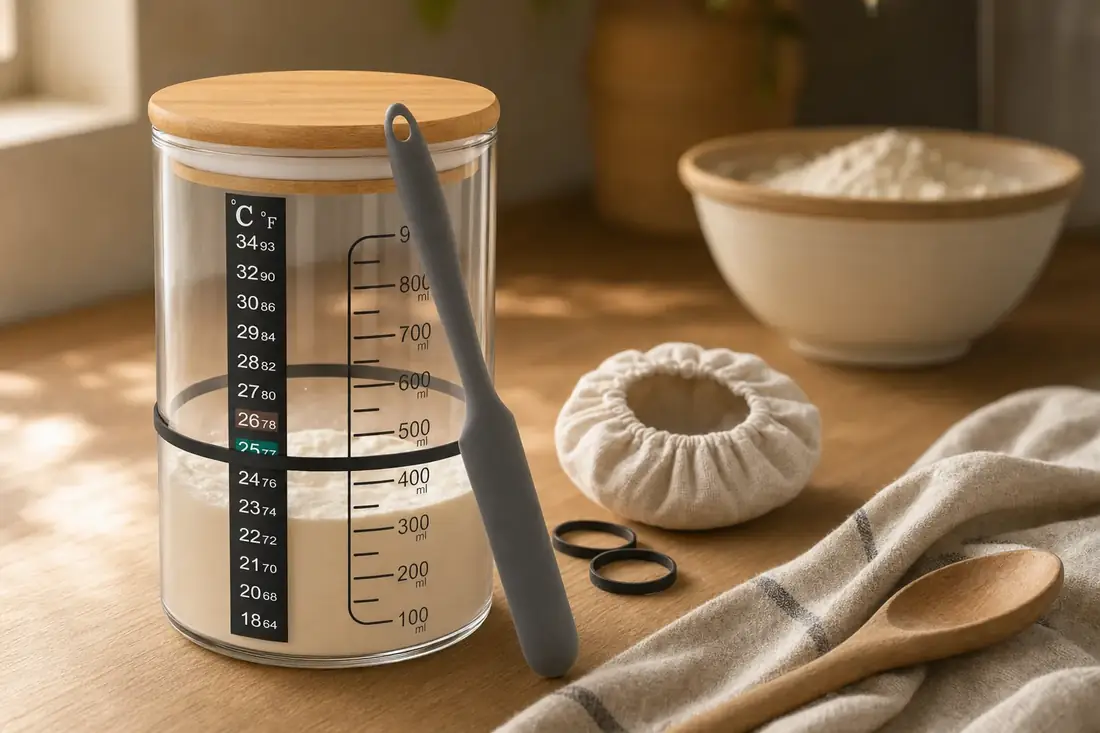
Both problems have the same cheap fix: retire the band. Rest the flat disc on the rim without screwing anything down — gravity keeps dust and fruit flies out, gas slips past the edge, and nothing is under load. Or skip the metal entirely and cover the mouth with a square of clean cloth held by an elastic band, which breathes on its own. Purpose-made starter jars settle this at the design stage with a lid that rests on the rim rather than fastening to it; with a mason jar you simply recreate that arrangement by leaving the band in the drawer.
Reading the rise on unmarked glass
Here is the mason jar's quietest limitation, and the one that matters most once the starter is alive: the glass tells you nothing about quantity. The walls carry embossed lettering and decorative texture — which actually gets in the way of reading the bubble structure — and where a measurement mark exists at all, it is molded glass-on-glass, the same color as everything behind it, legible only when the light catches it.
The standard workaround is the rubber band. Feed the starter, stretch a band around the jar at the new level, and check back later: the gap between the band and the surface is your rise. It works, and you should absolutely do it. The band drifts when the jar is picked up and wiped down. It marks one event, so tracking feed level and peak takes two bands and some discipline. And it gives you a distance, not a number — you eyeball whether the culture doubled rather than reading that it went from 200 to 400.
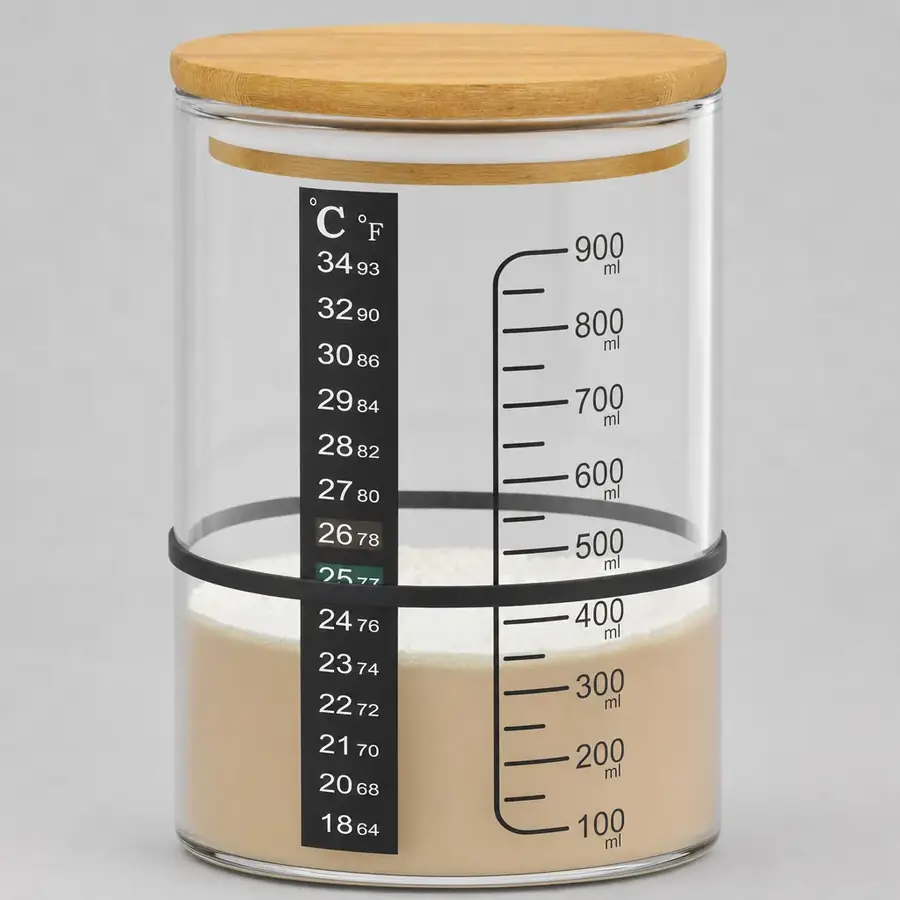
That last distinction does real work. A starter that climbs from 400 to 500 ml covers more glass than one that goes from 150 to 300, yet the first has barely stirred and the second has doubled. Height flatters full jars and slanders small cultures; only a ratio tells the truth. Numbers need graduations, and graduations are the main thing a jar with a printed scale adds over the mason jar it otherwise resembles — a contrasting scale down the side turns the same glance into a measurement.
What the mason jar setup looks like, assembled
Put the pieces together and the working configuration is this: a wide-mouth quart, the band retired, the disc resting loose or a cloth in its place, one rubber band riding at the feed line and a second left where the last peak reached. Kept scraped, that jar will run a starter for years.
Two habits carry the setup. Scrape the walls at every feed while the starter is still in the jar — the wide mouth exists so that this stays effortless. And move the band the moment you feed, not later, because a level mark set from memory is a guess wearing a uniform.
The fridge changes nothing structural, only the schedule. A mason jar goes into cold storage exactly as it sits on the counter — disc resting, never screwed — and storing a starter covers how the rhythm shifts once it is in there.
Where the mason jar stops and a starter jar begins
Everything the mason jar lacks, you have just added by hand: a breathable cover instead of the sealing lid, rubber bands instead of a scale, and nothing at all for temperature — the one variable that decides how fast a culture runs, invisible on plain glass no matter how you dress it.
A jar built for this job carries those answers on the jar itself. The one this site is written around holds 900 ml — the same useful territory as the quart — behind a printed 100-to-900 ml scale, with a stick-on strip reading from 64 to 93 °F down the side, a wooden lid that rests on the rim by design, and straight walls 3.9 in across that a hand and spatula enter without ceremony. The mason jar answers "can I keep a starter?" completely. The purpose-made jar answers the question that replaces it a month later: "what is my starter doing right now?" — as a number, at a glance, feed after feed.
Some numbers
the capacity of a purpose-made starter jar, graduated in 100 ml steps — the same working territory as a quart mason jar, with the scale printed where the mason jar leaves bare glass
— Technical sheet, 2026
starters sequenced across four continents in the largest survey of sourdough microbiomes to date. Healthy cultures vary enormously, which is why a jar you can read beats any rule of thumb about how yours should behave
— Landis et al., eLife, 2021
Where to go next
If the starter does not exist yet, the mason jar question is premature in the best way — feeding ratios and timing is the guide that will run your daily routine once it does, and it applies identically in a mason jar and any other. The two pages linked at the top — why glass, and the six criteria of a good jar — pick up where the mason-jar specifics end.