
What makes a sourdough starter jar worth owning
"Best" is a slippery word for an object this simple. A starter jar has one job — hold a living culture and let you read it — and the jars that do it well share a short list of properties. So rather than rank anything, here is the list, with what each item buys you and what it costs you to go without.
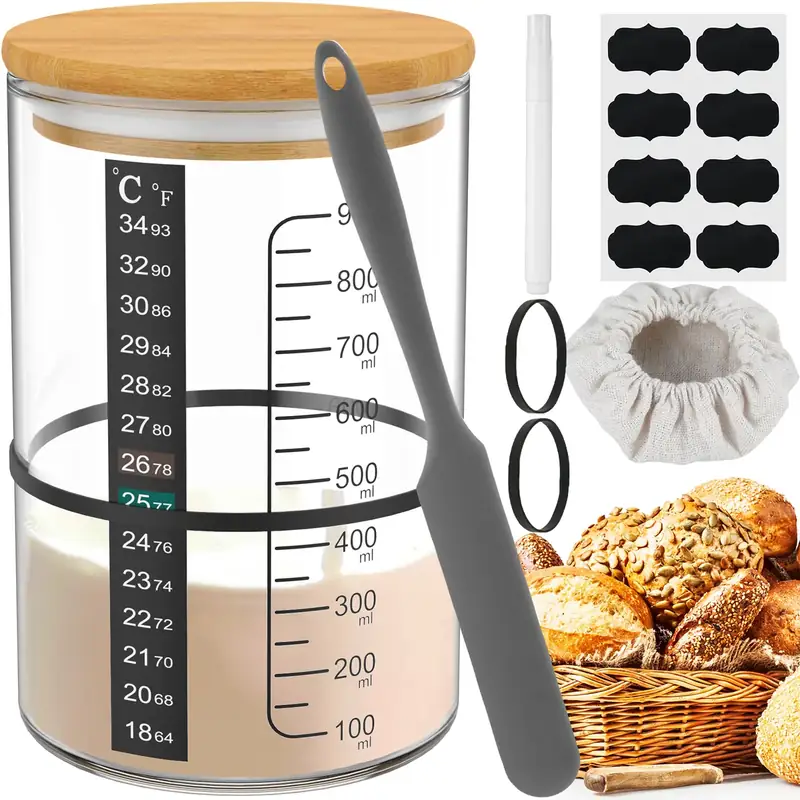
1. Capacity: about 900 ml
A starter doubles reliably and triples when it is very active, so the jar has to hold three times what you keep in it before things get tense. At 900 ml you can keep 200 ml of starter with genuine comfort, 300 ml with a triple reaching the rim, and 450 ml as an absolute ceiling.
Going smaller means feeding smaller amounts more carefully, and a lively culture will find the rim. Going much larger means washing a jar bigger than the job requires, and a thin layer of starter spread across a wide base is harder to read than a taller column.
2. A printed scale, not a sticker
This is the feature that changes how you bake, and it is the one most often missing. A starter is judged by ratio: did it double? Ratios need numbers, and numbers need graduations printed on the glass where they cannot peel, slide or fade.
Without a scale you compare heights, and heights mislead. A rise from 400 to 500 ml climbs further up the glass than one from 100 to 200 ml, yet the second doubled and the first moved by a quarter. Getting that backwards is how people conclude a healthy starter is failing.
3. A temperature reading on the jar itself
Fermentation speed tracks temperature closely, and what matters is the temperature of the jar, not the room. A strip reading 64 to 93 °F on the outside of the glass covers everything from a cold winter counter to a warm proofing spot.
Skip this and every slow rise becomes ambiguous. Is the culture struggling, or is it simply cold? Those two situations call for opposite responses — patience versus intervention — and without the number you cannot tell them apart.
4. Straight walls
A wall that runs true from base to rim lets a spatula take the whole side down in a single pass. Nothing is left to dry on, so the glass stays clear and the scale stays legible week after week.
Where a jar narrows toward the top, a ring of starter sits above the reach of any spatula, dries, and darkens. It does not harm the culture, but it does obscure the very surface you bought a graduated jar to read, and eventually it needs soaking off.
5. A wide mouth
3.9 in across is enough for a hand and a spatula together without knocking the rim. That sounds like a small convenience and it is actually a behavioral one: the easier the scrape-down, the more reliably you do it, and doing it every time is what keeps everything above true.
6. A lid that rests rather than seals
A starter produces carbon dioxide continuously and needs it to leave. A lid resting on the rim keeps dust out and lets gas go; a sealed one builds pressure until it hisses or pushes starter past the gasket. A sealed lid also traps moisture, which condenses down the walls and fogs the scale.
Having a second option helps: a breathable cloth cover with an elastic band, for the days the culture is at its most vigorous.
The two extras that separate a good jar from a very good one
The six above are the foundations. Two more items turn a jar you can read into a jar that keeps a record for you, and both cost almost nothing.
A band to mark the starting level. Slide it to the surface right after feeding and every subsequent observation is measured against a line you set yourself. This is what makes a rise a fact instead of an impression — and it is the only thing that catches the awkward case where a starter peaked and fell back while you were out. If the level sits below the band, it did not fail to rise; you missed the peak by an hour or two. Nothing else on the jar tells you that.
Labels and an erasable pen. Write the date and the feeding ratio on the glass, wipe, write again. It reads like the least essential item in any kit right up until the first morning you genuinely cannot remember whether you fed it yesterday or the day before — at which point you either guess or start over, and neither is a good outcome for a culture you have been building for weeks.
What none of this can do for you
A good jar makes a starter legible. It does not make one for you, and it does not remove the two weeks of daily feeding that brings a culture to life. What it does is shorten the learning curve considerably, because everything you would otherwise learn by trial and error is written on the side of the glass from day one: how far yours rises, at what temperature, in how many hours.
That is the case for spending on the jar rather than on accessories. The culture is free — flour, water and attention. The equipment that lets you read it is the part worth choosing carefully.
The six criteria, side by side
| Criterion | What to look for | This jar |
|---|---|---|
| Capacity | Roughly 3× what you keep | 900 ml |
| Scale | Printed on the glass | 100 to 900 ml, 100 ml steps |
| Temperature | Readable without a probe | Strip, 64–93 °F |
| Walls | Straight, base to rim | Straight |
| Mouth | Hand plus spatula | 3.9 in across |
| Lid | Rests, does not seal | Wooden lid, plus cloth cover |
Two extras earn their place beyond the six: an elastic band to mark your starting level, which turns a rise into a measurement, and chalk labels with an erasable pen so the jar remembers the date instead of you.
Numbers worth knowing
capacity, graduated in 100 ml steps — which puts the practical ceiling at 450 ml of starter
— Technical sheet, 2026
the span of the stick-on temperature strip, covering a cold counter through to a warm proofing spot
— Technical sheet, 2026
starters sequenced across four continents in the largest survey of sourdough microbiomes to date — healthy starters vary far more than folklore suggests, so your own numbers are the benchmark that counts
— Landis et al., eLife, 2021
Where to go next
The main product page goes into the scale and the strip in more depth. The starter kit page compares the two sets, why glass covers the material, the container page works through sizing, and sourdough tools lists the whole kit. For the routine: feeding, storing, cleaning. Just starting? Making a starter. See also what buyers reported and our standards.
Questions about choosing a jar
What makes one sourdough starter jar better than another?
Six things: enough capacity to double, a printed scale, a temperature reading, straight walls, a wide mouth and a lid that lets gas out. Miss any one of them and you lose either information about the culture or ease of maintaining it.
Does the jar really need a scale printed on it?
It is the single most useful feature. A starter is judged by ratio — did it double? — and a ratio needs numbers. Without a printed scale you are comparing heights, and a rise from 400 to 500 ml covers more glass than one from 100 to 200 despite being far less significant.
What capacity should I look for?
900 ml is a good target for home baking. It lets you keep 200 ml of starter with comfortable headroom for a triple, and it caps out at around 450 ml of starter if you need more. Much smaller and a lively culture escapes; much larger and you are washing a big jar for no reason.
Is a wide mouth actually important?
Yes, and it is underrated. At 3.9 in across, a hand and a spatula fit in without knocking the rim. That is what makes scraping the walls at each feed fast enough that you keep doing it — and clean walls are what keep the scale readable.