
A sourdough starter container sized around what a starter does
Container size is the first question everyone asks and the one that gets the vaguest answer. "Leave room to rise" is true and useless. What you need is a number, and since the capacity here is a fixed 900 ml, that number is arithmetic.
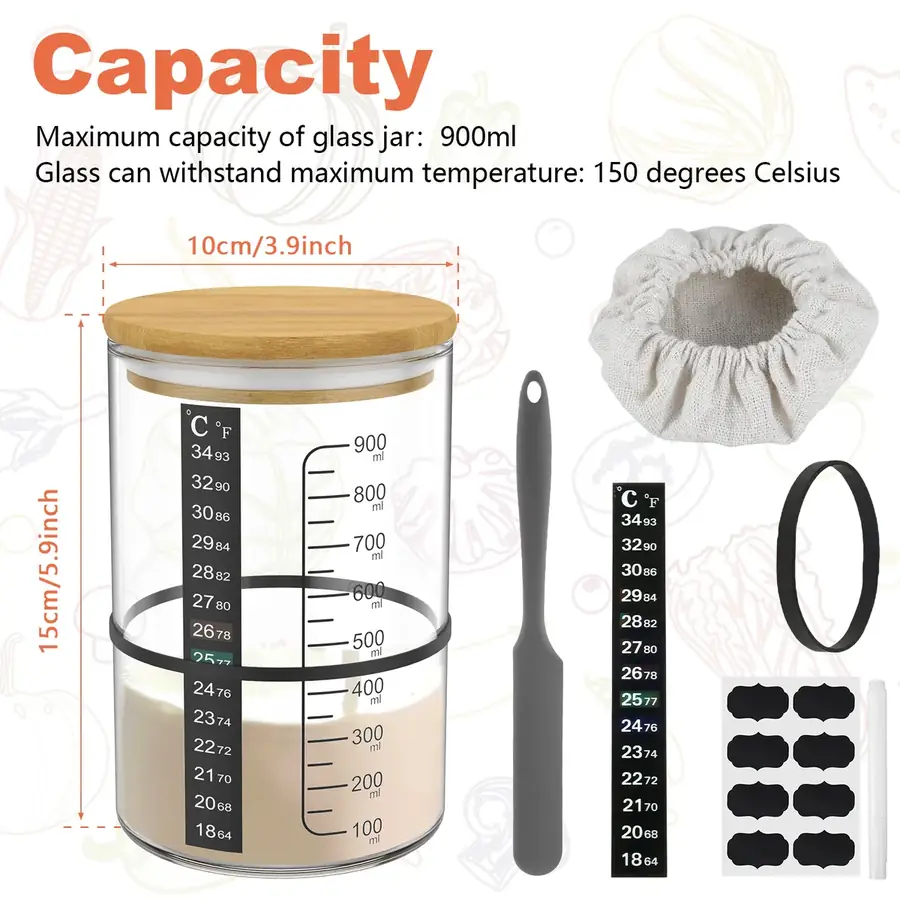
How much starter fits, worked through
A healthy starter doubles reliably and triples when it is at its most active. So the useful question is which starting volume survives both without climbing over the rim.
| You keep | Doubled | Tripled | Verdict |
|---|---|---|---|
| 100 ml (3.4 fl oz) | 200 ml | 300 ml | Plenty of room — good for small, frequent feeds |
| 200 ml (6.8 fl oz) | 400 ml | 600 ml | The everyday sweet spot |
| 300 ml (10 fl oz) | 600 ml | 900 ml | Fine doubled; a triple reaches the rim exactly |
| 450 ml (15 fl oz) | 900 ml | over | The hard ceiling |
| 600 ml (20 fl oz) | over | over | Too much for this size |
So "no more than half full" is right, and "a third full" is more comfortable. What makes this actionable rather than theoretical is that the 450 mark is printed on the glass — you can see the line you should not cross.
Counter or fridge
Where you keep the container decides how often you feed it, and both answers are legitimate.
On the counter suits anyone baking weekly or more. The culture stays active, feeds once or twice a day, and is ready whenever you are. The temperature strip earns its place here: a counter by a window in winter and a shelf above the oven in summer are different environments, and the strip tells you which one you have.
In the fridge suits occasional baking. Cold slows the culture right down, so it feeds weekly instead of daily. Take it out, give it a couple of feeds at room temperature before you bake, and it wakes up. Keep less in the container for fridge storage — the rise is gentler, so headroom matters less, and a smaller volume means less to discard each week.
Either way, the container is the same and the reading habit is the same. What changes is the interval. A counter starter is a daily relationship; a fridge starter is a weekly one, and the graduated scale matters just as much there — a culture that comes out of the cold and only manages a half-rise is telling you it wants a second feed before you bake, which is information you would otherwise get too late.
The storing guide walks through both routines in detail, including how to bring a fridge starter back up to speed.
Why the shape does as much work as the size
Two containers can hold the same 900 ml and be very different to live with.
Straight walls let a spatula take the whole side down in a single pass. Nothing dries into a ring where the glass curves, so the container stays clear and the printed scale stays readable — which is the entire reason you chose a graduated container in the first place.
A wide mouth, 3.9 in across, means a hand and a spatula fit in without knocking the rim. That is what makes scraping down fast enough to become habit rather than a chore you postpone.
Proportions that favor width over height. At 3.9 in across and 5.9 in tall, this container is deliberately squat. A taller, narrower one of the same capacity would show a bigger column for the same rise — which reads as more dramatic and means exactly the same thing — and would be far harder to reach into.
Reading the container instead of guessing at it
The reason a graduated container changes how you bake is that it converts every observation into a number you can act on. Three readings, all taken through the glass, and none of them requiring you to open anything.
The level, as a ratio. A starter that goes from 200 to 400 ml has doubled. One that goes from 400 to 500 has barely stirred, even though it climbed higher up the glass. Judged by height alone, the second looks like the bigger event — which is precisely backwards. Printed graduations remove the illusion.
The structure, through the wall. An active culture presses a webbed network of bubbles against the glass: coarse near the base, fine near the top. A sluggish one shows a dense mass with a few large voids. That difference is the gap between "it rose" and "it rose well", and it is the earliest signal that a feeding schedule needs adjusting.
The high-water mark. When a starter peaks and settles back while you are out, it leaves a dried tidemark on the wall. That line is a free measurement of a rise you never watched — and it only exists on a surface you can see through.
The lid, and why it rests
The wooden lid sits on the rim without sealing, and that is a deliberate choice rather than a shortcut.
Fermentation produces carbon dioxide without pause. In a sealed container that gas has nowhere to go: pressure builds until the lid hisses when you lift it, or until starter is pushed out around the edge. Neither is dangerous and both are a mess on the counter.
There is a second reason, less obvious and more annoying. A sealed container traps moisture along with the gas. The condensation runs back down the inside of the walls and fogs the very scale you bought a graduated container to read. A lid that breathes keeps the glass clear.
When the culture is at its most active — the days it triples — the cloth cover and elastic band give even more airflow while keeping dust and fruit flies off. Two ways to cover it, matched to how lively the starter is that week.
Specifications
| Jar capacity | 900 ml (30 fl oz) |
|---|---|
| Jar size | 3.9 in across × 5.9 in tall (10 × 15 cm) |
| Jar material | Clear glass, graduated 100–900 ml, with a °F / °C scale |
| Heat resistance | Up to 302 °F (150 °C) |
| Lid | Wooden lid |
| Cloth cover | 3.7 in (9.4 cm) across |
| Elastic band | 3.4 in (8.64 cm) |
| Thermometer | Stick-on strip, 5.09 in (12.95 cm) long, 64 to 93 °F (18 to 34 °C) |
| Spatula | Silicone, 9.48 in (24.1 cm) |
| Labels | Sheet of 8 chalk labels with an erasable pen |
| Food contact | Rated for food contact. No substances of concern declared. |
Numbers worth knowing
capacity, graduated in 100 ml steps — which puts the practical ceiling at 450 ml of starter
— Technical sheet, 2026
the temperature the glass is rated to, covering hot water and normal dishwashing
— Technical sheet, 2026
starters sequenced across four continents in the largest survey of sourdough microbiomes to date, which found the spread between healthy starters to be very wide
— Landis et al., eLife, 2021
Where to go next
The main product page covers the scale and the strip in detail, and the starter kit page lists what ships alongside. On the material, see why glass; on the vessel itself, the fermentation jar page; and for the whole toolkit, sourdough tools. Day to day: feeding and cleaning. New to it? Making a starter. You can also read what buyers reported.
Questions about containers
How big should a sourdough starter container be?
At least twice the volume of your starter, and three times is more comfortable. In this 900 ml container, 200 ml of starter is the everyday sweet spot and 450 ml is the ceiling — at 450 a doubling reaches the rim exactly.
Where should I keep the container?
On the counter if you bake weekly, in the fridge if you bake occasionally. The temperature strip tells you what the spot you chose is actually giving the culture, which matters more than the room the container sits in.
Should the container be sealed?
No. A starter releases carbon dioxide continuously and a sealed container builds pressure. The wooden lid rests on the rim and lets gas leave on its own; when the culture is very active, the cloth cover and band open the airflow further.
How often should the container be washed?
Scrape the walls down with the spatula at every feed and a proper wash every few weeks is enough. The straight sides mean nothing dries under a shoulder, which is what usually forces an early clean.